English

Views: 0 Author: Site Editor Publish Time: 2026-07-30 Origin: Site


Selecting a door mat is often treated as an afterthought, resulting in entryways plagued by inadequate floor protection, tripping hazards, and disproportionate aesthetics. A standard 36-inch residential door requires specific mat dimensions to effectively capture debris and moisture. Purchasing a mat without matching its dimensions to the door width, threshold clearance, and foot traffic patterns leads to premature wear and interior floor damage. This guide breaks down the exact measurement frameworks, standard versus oversized dimensions, and clearance requirements needed to select the correct Front Door Mats for single, double, patio, and custom entryways. We will cover how to evaluate your doorway to ensure maximum coverage, safety, and visual appeal without compromising the structural integrity of your weatherstripping.
The 80% Rule: A functional door mat must cover at least 80% of the active doorway width to ensure visitors step on it naturally.
Standard Sizing Baselines: The industry standard 18" x 30" mat is strictly for single doors; double doors, doors with sidelights, or sliding back doors require oversized or Custom Size Entrance Mats.
Clearance is Critical: Mat thickness (pile height) must be evaluated against the door’s bottom swing clearance to prevent snagging and weatherstripping damage.
Layering Proportions: When layering an accent rug beneath a functional mat, the base rug should extend exactly 2 to 4 inches beyond the top mat on all sides.
The mathematical baseline for entryway coverage relies on the 80% rule. For a standard 36-inch door, the mat must be at least 28.8 inches wide, making a 30-inch mat the bare minimum acceptable width. This ensures that anyone walking through the door naturally steps on the mat rather than bypassing it. If you install a mat that only covers 50% of the threshold, foot traffic will inevitably hit the unprotected flooring on either side.
Human stride dictates mat depth. A minimum depth of 18 to 24 inches ensures at least one full step, and preferably two, is taken on the mat before entering the home. This contact time is necessary for the mat to effectively scrape dirt and absorb moisture from footwear. In commercial or heavy residential applications, extending that depth to 36 inches guarantees both feet make contact with the scraping surface.
Architectural impact and curb appeal depend heavily on mat sizing. An undersized mat creates a "postage stamp" effect, where the entryway looks disproportionate. This visual imbalance harms curb appeal and cheapens the exterior aesthetic, regardless of the mat's material quality. Proper sizing anchors the entryway visually.
Door Width (Inches) | 80% Minimum Width (Inches) | Recommended Mat Width (Inches) |
|---|---|---|
32" (Narrow/Secondary) | 25.6" | 30" |
36" (Standard Single) | 28.8" | 30" or 36" |
48" (Single with Sidelights) | 38.4" | 48" |
72" (Double Doors) | 57.6" | 72" |
Understanding the standard sizing spectrum helps in selecting the right mat for your specific entryway configuration. You must match the physical footprint of the mat to the architectural layout of the door frame.
Small (18" x 30" / 1.5' x 2.5'): The absolute baseline for single standard doors.
Medium (24" x 36" / 2' x 3'): Recommended for high-traffic standard entryways, offering enhanced stride coverage.
Large / Oversized (36" x 48" or 3' x 4'): Ideal for wide entryways, commercial-style residential doors, or heavy debris zones.
The 18" x 30" standard size is highly available and cost-effective. However, it offers minimal coverage for heavy-duty weather zones. While it meets the basic 80% rule for a 36-inch door, it provides limited scraping area for frequent foot traffic. Upgrading to a 24" x 36" mat provides a much better buffer against mud and snow.
Entryways with sidelights expand the perceived width of the door. Stepping up to 24" x 36" or 3' x 5' dimensions is recommended. This larger size provides the visual framing required to balance the wider architectural footprint of the entryway. A small mat here looks entirely out of place.
Double doors necessitate 3' x 6' (36" x 72") mats. Placing two small standard mats side-by-side creates tripping hazards and allows moisture seepage between the seams, leading to floor damage and an unpolished appearance. A single, continuous mat is mandatory for safety and function.
Front entryways often prioritize aesthetics and scraping, while back yard and patio mats focus heavily on mud and moisture retention. Wide sliding glass doors often require ultra-wide, low-profile custom lengths to cover the entire active opening without obstructing the sliding mechanism or the screen door track.
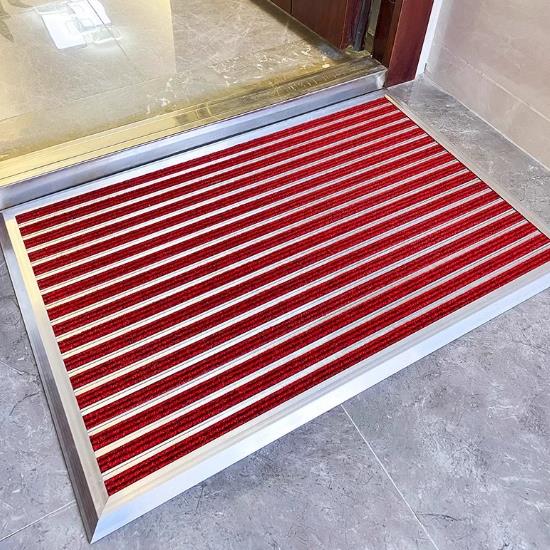
Non-standard entryways require specific solutions. Scenarios such as oversized pivot doors, wrap-around porches, recessed mat wells, or deep commercial vestibules demand dimensions outside standard retail offerings. You cannot force a standard mat into a recessed well; it will shift and create a severe tripping hazard.
Custom cutting involves material and manufacturing constraints. Some cut-to-length roll goods lack finished or beveled edges, which can lead to fraying or tripping hazards. It is crucial to specify factory-finished borders when ordering custom sizes. A heavy-duty rubber reducer edge ensures wheelchairs and heavy boots transition smoothly onto the mat surface.
Analyze the return on investment for custom sizing. While custom manufacturing carries a higher upfront cost, it offers an extended lifespan and superior floor protection in high-traffic environments. You save money on floor repairs, hardwood refinishing, and frequent mat replacements by installing the correct size from day one.
The threshold "swing" test is a necessary step before purchasing a mat. Measure the gap between the bottom of the door and the porch surface when the door is fully open. This clearance dictates the maximum allowable thickness of the mat. If your door has a weatherstripping sweep, you must measure from the bottom of the sweep, not the door slab.
Pile height directly impacts functionality. Low-profile mats, typically 1/4" to 3/8" thick, are ideal for tight clearances. High-pile coir or heavy-duty rubber mats, ranging from 5/8" to 1" thick, offer superior scraping capabilities but are prone to jamming under low-clearance doors. Jamming tears the weatherstripping and ruins the mat edges.
Consider compression over time. Natural materials like coir maintain their height and resist compression, requiring strict adherence to clearance measurements. Synthetic fibers may flatten with use, slightly increasing clearance over time but potentially reducing scraping efficiency. Always size the thickness based on the uncompressed state of the material.
Door Clearance Gap | Maximum Mat Thickness | Recommended Material Type |
|---|---|---|
Less than 3/8" | 1/4" | Low-profile synthetic, flat-weave |
3/8" to 5/8" | 3/8" to 1/2" | Standard rubber-backed, medium pile |
Greater than 5/8" | 5/8" to 1" | Heavy-duty coir, thick aluminum alloy |
The interior design debate regarding mat placement often pits aesthetics against function. The "vertical" argument suggests running the mat parallel to stride length to maximize shoe contact time and cleaning area. However, the "horizontal" placement, parallel to the threshold, remains the industry standard. It ensures physical safety, improves entryway aesthetics, and covers the entire active door width.
Oversized mats that extend past the porch edge, or mats without beveled rubber borders, create liability and safety risks. Edges that curl up become significant tripping hazards, especially in high-traffic areas. Always ensure the mat sits entirely flat on a level surface without overhanging steps or brick borders.
Using improperly sized, non-breathable rubber-backed mats on wooden decks or painted concrete poses risks. If the mat covers too much surface area, it can trap moisture underneath, causing wood rot or concrete discoloration over time. You must periodically lift the mat to allow the substrate to dry, especially after heavy rain.
Measure your active door width and calculate the 80% minimum coverage requirement.
Perform the threshold swing test to determine your maximum allowable mat thickness.
Select a standard 18"x30" for basic single doors, or order custom dimensions for double doors and sidelights.
Verify that your chosen mat material is compatible with your porch surface to prevent trapped moisture.
A: The industry standard size for a single residential front door mat is 18 inches by 30 inches. This size provides baseline coverage for a standard 36-inch wide door.
A: A door mat does not need to be wider than the door itself, but it should cover at least 80% of the active doorway width to ensure effective use.
A: The thickness depends on your door's bottom clearance. Measure the gap between the open door and the floor; the mat must be slightly thinner than this measurement to avoid snagging.
A: No, an 18x30 mat is too small for double doors. You need an oversized mat, typically 36 inches by 72 inches, to cover the width and prevent tripping hazards.
A: The industry standard is horizontal, running parallel to the threshold. This orientation covers the door width effectively and provides better visual proportion for the entryway.
A: Custom size entrance mats can be ordered from specialized commercial matting suppliers or manufacturers that offer cut-to-length roll goods with factory-finished borders.