
- All
- Product Name
- Product Keyword
- Product Model
- Product Summary
- Product Description
- Multi Field Search
 English
Views: 0 Author: Site Editor Publish Time: 2026-08-21 Origin: Site


Many homeowners buy an outdoor mat based purely on looks. They end up with a product that looks disproportionately small or physically blocks the door from opening. A mismatched mat compromises architectural curb appeal. It also ruins functional dirt-trapping capabilities. This failure leads to increased interior floor wear and higher maintenance demands over time. Selecting the correct dimensions requires a systematic approach. You must evaluate your specific entryway configuration. You need to balance standard sizing with clearance requirements. Understanding how foot traffic flows across the threshold is mandatory. We see this constantly in the field. People buy a tiny mat for a massive double door. The dirt tracks right past it. You need a mat that covers the active walking path. It must sit low enough to clear the door sweep. Let's break down the exact measurements and rules you need to follow to get this right the first time.
The Industry Baseline: The universally accepted standard size for a single residential door is 18" x 30", designed to fit the typical 36-inch wide American entryway.
The 80% Proportionality Rule: For optimal visual balance and functional coverage, a door mat should span at least 80% of the width of the door it services.
The Curb Appeal sweet spot: Upgrading to large front door mat sizes (like 21" x 33" or 24" x 36") significantly enhances architectural balance and perceived curb appeal compared to minimum baseline options.
Clearance is Critical: Length and width are irrelevant if thickness is ignored; outswing doors require strict measurement of the threshold gap to prevent binding.
Configuration Dictates Scale: Double doors, sidelights, and commercial entryways require scaling up to 24" x 36", 3' x 4', or custom dimensions to maintain efficacy.
Establishing a standard measurement in the manufacturing of entry mats relies on the dimensions of typical residential architecture. A standard size exists to provide a baseline solution. It fits the majority of single-door entryways without requiring custom fabrication. These dimensions offer sufficient surface area for debris removal. They also maintain visual proportionality with the door frame.
The most common residential size is the 18" x 30" medium-size mat. This industry standard directly correlates to the standard 36-inch exterior door. Placing a 30-inch wide mat in front of a 36-inch door leaves exactly three inches of exposed floor on either side. This creates a neat, framed appearance. It provides adequate coverage for a person stepping squarely through the center of the doorway. It serves as a highly functional baseline for standard residential traffic.
Manufacturers also offer intermediate upgrades. These typically measure 21" x 33" and 22" x 36". These sizes solve the aesthetic deficit sometimes created by the 18" x 30" mat on wider porches. They fill the visual space more effectively. They do this without requiring the physical depth of a larger mat. This makes them ideal for narrow stoops where a deeper mat might overhang the top step. Upgrading to these dimensions enhances the entryway's presence while maintaining practical clearance.
For larger single doors or entryways with expansive porches, the 24" x 36" upscale standard provides enhanced footfall coverage. This size commands more visual weight. It anchors the entryway design. The increased depth allows users to take a full stride on the mat. This significantly improves soil and moisture removal before they cross the threshold.
The 3' x 4' stoop standard serves as a transitional option. It works well for deeper entryways and high-traffic residential thresholds. This larger footprint acts almost like a small landing pad. It accommodates multiple people standing at the door simultaneously. It ensures that even hurried footsteps make contact with the scraping surface.
The mathematical framework for sizing relies heavily on the 80% rule. Covering 80% to 100% of the active door width is the baseline requirement. This captures debris from a standard stride. If a mat covers less than 80% of the door's width, users step around it. They might only make partial contact. This renders the mat ineffective. Applying this rule ensures that the chosen door mat functions as an unavoidable cleaning zone.
Mat Size | Best Door Type | Coverage Depth | Primary Benefit |
|---|---|---|---|
18" x 30" | Standard 36" Single Door | 1 Step | Fits narrow stoops perfectly. |
21" x 33" | Standard 36" Single Door | 1.5 Steps | Better visual balance. |
24" x 36" | Oversized Single Door | 2 Steps | Maximum dirt trapping for single doors. |
36" x 48" | Doors with Sidelights | 2+ Steps | Acts as a full landing pad. |
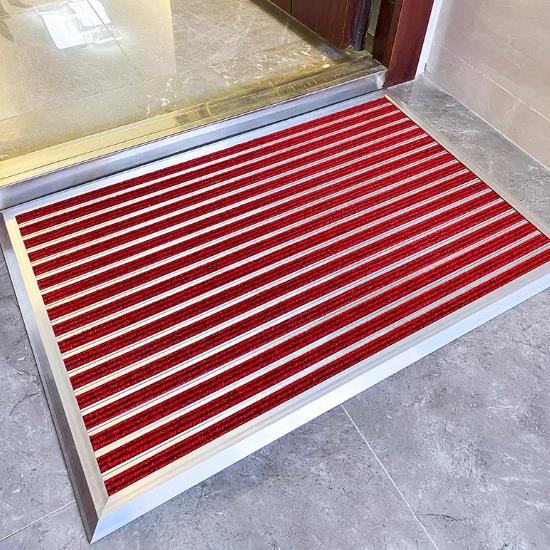
Sizing recommendations must adapt to specific architectural layouts and traffic profiles. A single sizing rule cannot accommodate the diverse range of residential entryways. You must evaluate the physical space. You need to watch how people move through it to determine the optimal mat dimensions.
For standard single doors with a 36-inch width, the choice generally falls between the baseline 18" x 30" medium-size and the upgraded 21" x 33" or 24" x 36" large-size Standard Outdoor Door Mats. Optimal placement involves positioning the mat to capture two full steps before interior entry. The larger 24" x 36" option excels here. Its 24-inch depth practically guarantees that both the left and right foot will strike the mat during a normal walking cadence.
Single doors flanked by sidelights require a different approach. The visual width of the entryway expands significantly. A standard 30-inch wide mat looks entirely out of place here. You must size up to maintain visual and functional harmony. Recommended sizes include 24" x 36" or 3' x 4' mats. These larger dimensions match the total visual width of the door-plus-sidelight framing. They ground the entrance and provide a proportional landing zone.
Double doors and grand entrances present openings spanning 60 to 72 inches. A standard single-door mat fails both aesthetically and functionally in this scenario. You must ensure both doors have active mat coverage. This is especially true if both are frequently opened. Extra-long runner styles or standard 3' x 6' dimensions are required. This continuous coverage prevents dirt from being tracked in when the secondary door is utilized.
Sliding glass and patio doors feature unique traffic flows. Users often approach these doors from various angles rather than straight on. Wider, narrower profiles accommodate this lateral movement. Sizes like 2' x 4' or 2' x 5' work best. These elongated mats provide extensive coverage along the track. They do this without encroaching deeply into the outdoor living space. This keeps patios and decks clear for furniture and foot traffic.
Measure the total width of the active door opening.
Add the width of any sidelights to your total measurement.
Select a mat width that covers at least 80% of that total number.
Verify the depth of your porch to ensure the mat does not overhang the top step.
Evaluating a mat requires shifting focus from its basic footprint to its three-dimensional specifications and material density. Length and width dictate coverage. Thickness and weight determine operational success and longevity.
Pile height is a critical metric. It defines thickness and door clearance tolerances. You must measure the sweep space. This is the gap between the bottom of the door and the porch floor. Outswing doors are particularly vulnerable to clearance issues. If the mat is thicker than the sweep space, the door will catch. It will drag or bind against the mat. This creates frustration. It damages the mat. It can even compromise the door's weatherstripping. Always verify that the mat's maximum thickness is at least a quarter-inch lower than the threshold gap.
Depth directly impacts dirt removal through stride mechanics. The front-to-back measurement matters. A minimum depth of 18 inches is required. This guarantees at least one foot makes contact during a normal stride. However, 24 to 36 inches of depth guarantees both feet make contact. This extended footfall coverage doubles the scraping action. It significantly reduces the volume of soil transferred to interior floors.
Material density plays a massive role in the performance of Heavy-Duty Entrance Mats. Size interacts directly with weight. Larger mats require heavier backing materials. Vulcanized rubber is a great example. It maintains stability. In high-exposure environments, lightweight mats suffer from wind-lift. They shift dangerously underfoot. A dense, heavy backing ensures the mat remains firmly anchored. It provides a safe and reliable scraping surface regardless of weather conditions.
Clearance Gap | Recommended Mat Thickness | Door Type Compatibility |
|---|---|---|
Less than 0.5 inches | 0.25 inches (Low Profile) | Outswing / Tight Inswing |
0.5 to 1.0 inches | 0.375 to 0.5 inches | Standard Inswing |
Over 1.0 inches | 0.75 inches or greater | High Threshold / Step-down |
Preemptively identifying frequent buyer errors ensures a successful installation. Many sizing mistakes stem from prioritizing aesthetics over physical constraints. Failing to account for environmental factors is another major issue.
Undersizing creates the postage stamp effect. Placing a small 18" x 30" mat in a grand, expansive entryway diminishes the home's curb appeal. It looks like an afterthought rather than a cohesive design element. Functionally, an undersized mat fails to capture debris effectively. Users can easily step over or around it. Always scale the mat to the proportions of the surrounding architecture.
Ignoring outswing versus inswing mechanics is a critical safety error. Purchasing a thick, heavy-duty mat for an outward-opening door with low clearance results in a severe trip hazard. The door pushes the mat away. It bunches it up. Sometimes the user is unable to open the door fully. Always measure the sweep space before selecting a mat for an outswing door.
Weather exposure causes material shrinkage and expansion in certain natural fibers. Coir mats may swell when saturated with water. They shed heavily over time. This effectively changes their functional footprint and appearance. Synthetic materials maintain strict dimensional stability. If the entryway is fully exposed to rain and snow, selecting materials that resist swelling and degradation is essential for long-term performance.
Buyers often face compromises during the final selection process. Balancing the desire for a beautiful entryway with the necessity of aggressive dirt removal requires careful consideration of the available options.
Decorative layering has become a popular trend. This involves placing an 18" x 30" functional mat over a larger 24" x 36" or 3' x 5' decorative outdoor rug. The primary advantage is enhanced curb appeal. It allows homeowners to introduce patterns and colors while maintaining a scraping surface. However, this setup traps moisture between the layers. This potentially damages the porch surface. It also increases the overall height. This creates a higher trip hazard and complicates door clearance.
Choosing between custom sizing and off-the-shelf standards involves weighing cost against precision. Standard sizes like 18" x 30" or 3' x 4' offer cost-efficiency and immediate availability. They work perfectly for the vast majority of standard doors. Custom-cut architectural mats provide a precise edge-to-edge fit. They are ideal for recessed wells or uniquely shaped vestibules. Custom mats deliver superior aesthetics and exact coverage. However, they carry a premium cost and require longer lead times for fabrication.
The minimum standard size for a single outside door mat is 18" x 30". Upgrading to a larger size such as 21" x 33" or 24" x 36" provides superior visual balance and dirt-trapping efficiency. Proper sizing ensures the mat functions as an active barrier against exterior soil rather than a passive decoration.
Measure the exact width of your door frame to establish the baseline requirement.
Calculate the 80% minimum coverage rule to ensure the mat will capture standard foot traffic.
Measure the threshold clearance carefully, especially for outswing doors, to prevent binding.
Select a material density and backing type suited to your specific weather exposure and wind conditions.
A: For a standard 36-inch door, the minimum recommended size is 18" x 30". Upgrading to a 21" x 33" or 24" x 36" mat provides better visual balance and ensures both feet make contact with the scraping surface before entering.
A: A medium-size doormat typically measures 18" x 30" and is designed for basic clearance and standard single doors. A large front door mat usually measures 24" x 36" or larger, offering greater depth for full-stride coverage and better proportionality for wide porches.
A: Yes, an outside mat can be wider than the door. This is often recommended for entryways with sidelights or expansive porches. A wider mat anchors the space visually and captures debris from users approaching at an angle.
A: The ideal thickness depends entirely on your door's sweep clearance. The mat must be at least 1/4-inch thinner than the gap between the bottom of the door and the floor to prevent dragging, especially for outswing doors.
A: Measure the total width of both doors combined. The mat should cover at least 80% of this total width. Standard double door mats typically measure 3' x 6' or require a custom runner to ensure adequate coverage across the entire opening.
A: Yes, heavy-duty mats are available in standard residential sizes like 24" x 36" and 3' x 4'. These mats feature denser materials and heavier rubber backing to withstand high traffic and severe weather without shifting.
A: If your door has sidelights, you should size up to match the total visual width of the door and the sidelights combined. A 24" x 36" or 3' x 4' mat usually provides the necessary scale to keep the entryway looking balanced.