
- All
- Product Name
- Product Keyword
- Product Model
- Product Summary
- Product Description
- Multi Field Search
 English


A modern entrance barrier is an engineered system designed to protect interior flooring and mitigate slip-and-fall liabilities. Every building faces the constant threat of uncontrolled dirt, mud, grit, and moisture ingress. Left unchecked, these elements destroy floor finishes. They increase maintenance demands and create severe safety hazards across all entryways. You must evaluate material composition, backing types, dimensional clearance, and environmental exposure. This builds an effective defense system. Understanding how different fibers and rubber compounds interact with foot traffic allows you to stop debris at the threshold. A properly specified door mat acts as the primary filter for your building. This guide breaks down the science of entrance matting. It helps you implement a strategy that preserves your interior floors and ensures safe passage for everyone walking through your doors.
Function Dictates Material: The efficacy of a door mat depends entirely on its material—abrasive materials (like coir or molded rubber) scrape heavy debris, while synthetic textiles (like polypropylene) absorb moisture.
The Two-Mat System is Standard: Optimal floor protection requires an outdoor scraper mat paired with indoor entrance door mats to capture 100% of incoming debris and moisture.
Safety and Compliance Matter: High-quality mats must feature slip-resistant backings (like nitrile rubber), drainage holes for wet environments, and beveled edges to prevent curling and tripping hazards.
Sizing is a Performance Metric: A mat is only effective if it is large enough to accommodate at least two full strides (four footfalls) before a person steps onto the bare floor.
A functional entrance mat must meet strict baseline expectations to perform effectively in the field. It must actively trap debris, scrape mud from footwear, hold moisture without leaking onto the subfloor, and remain completely stationary under heavy foot traffic. If a mat shifts, curls, or fails to retain water, it ceases to be a protective tool and becomes a liability. You need a system that works passively as people walk over it. They should not have to stop and wipe their feet for the mat to do its job.
It is important to differentiate between standard consumer products and performance-driven solutions. Basic Welcome Floor Mats often prioritize aesthetics and light scraping. They work fine for low-traffic residential side doors. In contrast, heavy-duty Entrance Door Mats prioritize high-volume moisture containment, structural durability, and aggressive soil removal required for main entryways. The construction differences are vast. Performance mats use extruded synthetic fibers and vulcanized rubber. Consumer mats often rely on printed fabrics and cheap vinyl backings that degrade quickly.
Entrance solutions require a dual-action approach: moisture retention and dirt scraping. Different environments demand different ratios of these two functions. An entryway exposed to heavy snow requires aggressive scraping and high moisture capacity. A dry, dusty environment relies more on fine dust retention and static capture. Balancing these needs dictates the type of surface texture and fiber density required. You must assess your local climate before selecting a matting profile.
Bare floors carry significant safety implications. Tracked-in silica and sand act like sandpaper under foot traffic. They grind away the finish on hardwood, luxury vinyl, and polished stone. Furthermore, wet hard-surface flooring dramatically increases slip risks. A properly deployed matting system captures these hazards before they reach the interior. This preserves the floor finish and maintains safe traction for all occupants.
Feature | Standard Consumer Mats | Performance Entrance Mats |
|---|---|---|
Primary Focus | Visual aesthetics and greeting | Moisture containment and soil removal |
Backing Material | PVC or low-grade vinyl | Nitrile rubber or heavy-duty molded rubber |
Edge Design | Square cut, prone to fraying | Beveled safety edges to prevent tripping |
Traffic Capacity | Low (residential side doors) | High (main entryways, heavy footfalls) |
Relying on a single mat rarely provides adequate protection. The industry standard for optimal debris control is the two-mat entrance system. This approach utilizes specific zones to scrape and absorb. You separate the heavy lifting from the fine detailing. This extends the lifespan of both mats and keeps your interior floors completely dry.
The exterior mat tackles the heaviest soil. Materials designed for outdoor use include unbacked coiled vinyl, heavy-duty molded rubber, or rugged natural coir. These materials feature aggressive profiles that dislodge caked-on mud, snow, and large grit from shoe treads before the user even crosses the threshold. You want a surface that acts like a brush against the bottom of a shoe.
Outdoor mats must feature drainage holes or unbacked flow-through designs. This prevents water pooling, ice formation, and safety hazards during heavy rainfall or snow. A solid-backed mat placed outdoors will quickly become a slippery puddle. It defeats its primary purpose. Flow-through designs allow water to pass directly through the mat and drain away from the walking surface.
Evaluate the primary exterior debris type (mud, snow, or dry sand).
Select an aggressive scraping profile matched to that debris.
Ensure the mat has adequate drainage for your local precipitation levels.
Verify the mat is heavy enough to resist wind displacement.
Once the heavy debris is removed outside, the indoor mat acts as the absorber. Materials designed for interior moisture capture and fine debris removal include microfiber, nylon, and polypropylene. These synthetic fibers wick moisture away from shoe soles. They trap fine dust particles deep within their pile. The goal here is drying the shoe completely before it hits the hard surface flooring.
Impermeable backings are crucial for indoor mats. A high-quality solid backing prevents trapped moisture from seeping through. It stops water from rotting wood, staining tile, or damaging the subfloors beneath the mat. The backing also provides the necessary friction to keep the mat anchored safely in place. You must never use a flow-through mat indoors unless you have a dedicated floor drain installed beneath it.
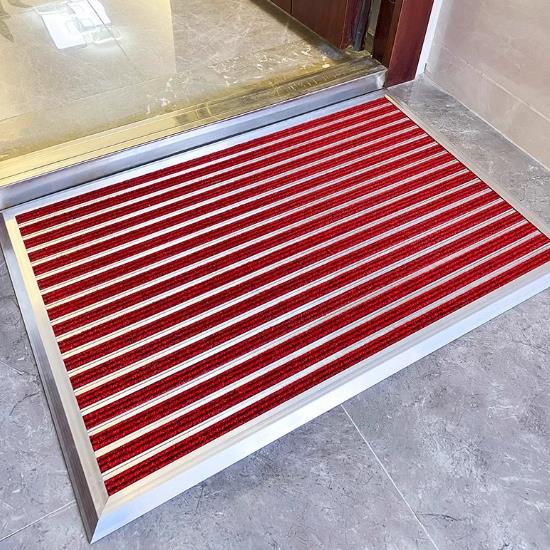
Understanding material properties ensures you select a mat capable of handling your specific environmental challenges. You cannot judge a mat by its color or pattern. You must look at the polymer chemistry and fiber construction. This determines how the mat will perform after six months of heavy foot traffic and weather exposure.
Coir, derived from coconut husks, offers excellent scraping ability and a traditional aesthetic. It is environmentally sustainable and highly effective at removing dry dirt. The stiff bristles dig deep into shoe treads. However, natural fibers have a high shedding rate. They hold moisture poorly compared to synthetics. If left saturated in standing water, coir is prone to rot and degradation. You should only deploy coir in covered outdoor areas protected from direct rainfall.
Rubber and nitrile compounds deliver extreme durability and chemical resistance. This is crucial for surviving winter ice melts and road salts. Nitrile lays flat consistently and resists edge curling. These materials are ideal for integrated drainage systems and heavy scraping. Their main drawback is a purely utilitarian appearance and zero moisture absorption. To contain water, rubber mats must be molded with raised containment borders. These water dam edges hold liquid until it evaporates or is manually removed.
Synthetic textiles like polypropylene and nylon excel at high moisture wicking. They feature a crush-resistant pile that withstands heavy footfalls. They are easily washable, stain-resistant, and dry quickly. Polypropylene is naturally hydrophobic, meaning the fibers themselves do not absorb water; instead, they trap water between the fibers. Nylon offers superior crush resistance and color retention. However, these textiles require a high-quality rubber backing to prevent slipping on hard floors. Inferior PVC or vinyl backings will harden, crack, and slip over time.
Personalized welcome floor mats offer unique styling. However, the manufacturing technique heavily impacts performance. Superficial ink prints wear off quickly under high traffic. The abrasive action of shoes acts like sandpaper on surface-level dyes. For longevity, look for solution-dyed fibers or molded-in patterns. Solution dyeing mixes the color pigment directly into the liquid polymer before the fiber is extruded. This means the color goes all the way through the fiber, making it highly resistant to fading and wear.
Material Type | Primary Function | Best Placement | Key Advantage |
|---|---|---|---|
Coir | Aggressive Scraping | Covered Outdoor | Eco-friendly, removes heavy dry dirt |
Nitrile Rubber | Scraping & Drainage | Fully Outdoor | Chemical resistant, will not crack or curl |
Polypropylene | Moisture Absorption | Indoor Entryway | Quick drying, highly stain resistant |
Nylon | Fine Dust Capture | Indoor Entryway | Crush resistant pile, excellent color retention |
A high-quality material is useless if the mat is too small to perform its job. Proper sizing and placement dictate the success of your entrance coverage. You must measure the physical space and understand the mechanics of walking to specify the correct dimensions.
Effective debris removal requires a mathematical approach to sizing. A standard small mat only captures one footfall per person. To properly clean shoe treads, a person must take at least two full strides on the matting surface. This requires a minimum of 3 to 6 feet of linear matting. Extending the length guarantees that moisture and grit are transferred to the mat rather than your interior floors. In high-traffic areas, extending the matting to 10 or 12 feet ensures maximum moisture removal during severe weather events.
Before placing a mat, you must measure the threshold gap. This is the space between the bottom of the door and the floor. You must balance the need for a plush, high-absorbency mat with the reality of your door's clearance. If a mat is too thick, the door will catch and drag it out of place. This damages the mat and creates a tripping hazard. Low-profile mats are engineered specifically for doors with minimal bottom clearance. They ensure smooth operation without sacrificing floor protection.
Open the door fully and inspect the sweep or weatherstripping.
Measure the distance from the bare floor to the lowest point of the door bottom.
Select a mat with a total thickness at least 1/8 inch less than your measured clearance.
Test the door swing to ensure it clears the mat without any friction.
Verify the mat backing grips the floor securely to prevent shifting during door operation.
Even well-intentioned entrance setups can fail if the wrong products are deployed in the wrong environments. Understanding failure modes helps you avoid common installation mistakes. You must anticipate how the mat will react to temperature changes, moisture loads, and chemical exposure over time.
The most common failure point is edge curling. Mats backed with cheap PVC or vinyl react poorly to temperature fluctuations. As the material expands and contracts, the edges curl upward. This creates severe tripping hazards. It also allows dirt to sweep under the mat, defeating its purpose. Investing in nitrile rubber backings ensures the mat lays flat regardless of thermal changes. Nitrile remains flexible in freezing temperatures and stable in extreme heat.
Using an indoor-rated, solid-backed mat in an uncovered outdoor environment leads to immediate failure. Without drainage holes, rainwater pools on the surface and saturates the fibers. This creates a slippery surface. It encourages mold growth and renders the mat useless for incoming foot traffic. You must match the backing type to the exposure level. Solid backings stay inside; flow-through backings go outside.
Winter road salts and harsh ice melts rapidly degrade inferior mat materials. These chemicals break down low-grade rubber and bleach synthetic fibers. This degradation leads to floor staining beneath the mat and premature structural failure. The plasticizers in cheap vinyl leach out when exposed to harsh chemicals, causing the backing to become brittle and crack. Selecting chemically resistant nitrile and solution-dyed synthetics prevents this winter weather damage.
Evaluating entrance matting requires looking at long-term performance rather than just the initial acquisition. You must factor in replacement frequency, maintenance labor, and the protective value the mat provides to your permanent flooring.
The lifecycle of a mat varies wildly based on its construction. Replacing a cheap big-box store mat annually due to fading, curling, or backing failure quickly adds up in effort and replacement frequency. Investing in a commercial-grade, nitrile-backed mat provides a solution that can last a decade. It maintains its structural integrity and safety profile year after year. The heavier face weight of commercial fibers resists crushing, keeping the mat looking new long after consumer-grade options have flattened out.
Consider the hidden demands of maintenance. A mat that cannot be easily cleaned loses its functionality as it becomes saturated with dirt. Evaluate whether the mat can be machine washed, hosed off in the driveway, or if it requires professional hot water extraction. Easy-to-clean mats ensure continuous performance and better indoor air quality. Rubber scraper mats simply need a quick hose down. Deep pile synthetic mats require regular vacuuming to pull dry particulate out of the fiber base.
An entrance mat is an engineered tool critical for building maintenance and safety. It functions far beyond a simple decorative greeting. By understanding material properties and sizing requirements, you can effectively stop dirt and moisture at the door. You protect your interior finishes and provide a safe walking surface for everyone entering the building.
Measure the threshold clearance of your doors to ensure low-profile compatibility.
Audit your local weather conditions to determine the necessary ratio of scraping to absorbing materials.
Inspect your current entryway for curling edges or water pooling to eliminate immediate slip risks.
Upgrade to nitrile-backed solutions for hard-surface floors to prevent shifting and chemical degradation.
A: The best materials for outdoor use are heavy-duty molded rubber, unbacked coiled vinyl, and natural coir. These materials excel at aggressive scraping and feature flow-through designs or drainage holes to prevent water pooling and ice formation.
A: Mat thickness depends on your door's threshold clearance. Standard low-profile mats range from 1/4 inch to 3/8 inch thick, allowing doors to swing freely without catching. Always measure the gap between the floor and the door bottom before purchasing.
A: Yes, a two-mat system provides maximum protection. The outdoor mat scrapes heavy mud, snow, and grit, while the indoor mat absorbs remaining moisture and traps fine dust, ensuring no debris reaches your bare floors.
A: To prevent sliding, use mats with high-quality nitrile rubber backings or place a dedicated non-slip rug pad underneath. Avoid cheap PVC or vinyl backings, as they harden over time, lose their grip, and can damage floor finishes.
A: It depends on the material. Many indoor cotton, microfiber, and flexible nylon mats with rubber backings are machine washable. However, heavy rubber, coir, and stiff outdoor scraper mats should only be shaken out or hosed off manually.
A: A commercial-grade, nitrile-backed mat can last 5 to 10 years even under moderate to heavy traffic. Cheaper vinyl-backed or natural fiber mats typically degrade, curl, or shed heavily within 1 to 2 years and require frequent replacement.
A: The durability of custom mats depends on the manufacturing method. Superficial printed inks fade quickly under heavy traffic and weather. For longevity, choose mats with molded-in patterns, flocked designs, or solution-dyed fibers that resist fading and wear.