
- All
- Product Name
- Product Keyword
- Product Model
- Product Summary
- Product Description
- Multi Field Search
 English
Views: 0 Author: Site Editor Publish Time: 2026-08-04 Origin: Site


Placing an improperly sized door mat at your threshold guarantees operational failure and visual disproportion. A mat that is too small fails to trap adequate dirt, creates immediate tripping hazards, and diminishes curb appeal by looking like a postage stamp in front of a grand entryway. Conversely, a mat that is too thick or excessively large for the clearance space will bind against the door sweep, causing premature edge wear and potential damage to the weatherstripping.
Standard retail sizes often fail to accommodate modern architectural variations. Double doors, sidelights, recessed wells, and low-clearance thresholds require precise dimensioning that off-the-shelf options simply cannot provide. Relying on generic sizes for complex entryways leads to functional failure, as foot traffic naturally bypasses the protective surface.
Implementing a systematic framework for measuring entryways, evaluating door clearance, and determining exact dimensions ensures optimal performance, safety, and visual balance. Proper sizing transforms a basic floor covering into a highly effective dirt-trapping system.
The 80% Rule: A functional door mat must cover at least 80% of the active door width to maintain visual balance (curb appeal) and ensure consistent foot traffic coverage.
Clearance is Critical: Mat thickness (pile height) must be evaluated against the door's swing arc to prevent binding, edge curling, and threshold damage.
Stride Length Dictates Depth: Effective debris removal requires a minimum depth that accommodates at least two full steps (typically 24 to 36 inches minimum for primary entrances).
Customization for Complex Entries: Double doors, recessed wells, and sidelight configurations frequently necessitate custom size door mats to avoid piecemeal coverage and structural hazards.
Metric vs. Imperial Awareness: Be mindful of imported designer sizes (such as European 650x1200 mm configurations) which fall between standard domestic sizes and can impact fit and centering.
Before evaluating aesthetics or material composition, a mat must meet strict baseline requirements for spatial coverage and operational clearance. Front Entrance Mats serve as the primary defense against exterior debris entering the interior environment. If the dimensions do not align with the architectural frame and human gait, the mat fails its primary function. We see this constantly on job sites where beautiful flooring is ruined within months because the entry system was an afterthought.
Architectural standards dictate that a mat's width should closely match the door frame. The absolute minimum requirement is covering 80% of the active door width. Falling below this threshold results in bypassed edges, where visitors step half on the mat and half on the bare floor. This creates concentrated wear patterns on the interior flooring and introduces a significant tripping hazard. Visually, a mat narrower than 80% of the door width breaks the symmetry of the entryway, reducing curb appeal and making the entrance look unfinished. When framing an entry, the visual weight of the floor covering must anchor the vertical lines of the door casing.
The mechanics of shoe cleaning rely on sustained contact between footwear and the scraping surface. Depth—the front-to-back measurement—is more critical than width for interior floor protection. Effective debris removal requires the mat to accommodate at least two full steps from an adult walking at a normal pace. A depth of 18 inches only captures a single footfall, allowing the other shoe to carry dirt directly inside. A minimum depth of 24 to 36 inches ensures both shoes make contact with the scraping surface, significantly reducing the volume of tracked-in soil. In commercial settings, we push for 10 to 15 feet of walk-off, but for residential applications, hitting that two-step minimum is non-negotiable.
Threshold height and weatherstripping dictate the maximum allowable pile height of the mat. The "swing arc" is the path the bottom edge of the door travels as it opens over the exterior surface. If the mat thickness exceeds the clearance of this arc, the door will drag across the surface. This causes the mat to bunch up, curl at the edges, and eventually tear. Furthermore, continuous friction damages the door's bottom sweep, compromising the building's weather seal. Identifying the lowest point of the swing arc is mandatory before finalizing any mat dimensions. You have to account for seasonal swelling in wood doors and the compression of rubber bulb seals.
Mapping standard market sizes to specific architectural layouts streamlines the selection process. While custom dimensions are sometimes necessary, many standard entryways can be outfitted effectively by understanding how off-the-shelf sizes correspond to common door widths. You just need to know which rules to apply to which frame.
Door Width | Minimum Mat Size | Optimal Mat Size |
|---|---|---|
32" (Narrow Single) | 18" x 30" | 24" x 36" |
36" (Standard Single) | 24" x 36" | 36" x 48" |
42" (Oversized Single) | 24" x 36" | 36" x 60" |
60" (Standard Double) | 36" x 60" | 36" x 72" |
72" (Large Double) | 36" x 72" | 48" x 72" or Custom |
For a standard 36-inch residential door, the ubiquitous 18" x 30" mat is fundamentally inadequate. It fails the 80% width rule and lacks the depth for a two-step stride. The 24" x 36" format represents the minimum viable size for a standard single door. It aligns perfectly with the width of the door frame, providing proper spatial proportion and sufficient depth to capture debris from both feet before entering the building. Anything smaller is just a decorative trip hazard.
The global market introduces mid-sized and metric alternatives, such as the European 650x1200 mm configuration (approximately 26" x 47"). These elongated "transit" sizes fall between standard domestic dimensions. They function exceptionally well on wider single doors or tight-clearance entranceways where depth is restricted but lateral space is abundant. However, they can appear off-center if placed in front of a standard 36-inch door without sidelights. You have to measure the casing, not just the slab, to see if these metric sizes will look right.
Entryways featuring one or two sidelights require a specific sizing ratio. The mat should ideally span the entire architectural frame, including the sidelights, rather than just the active door width. Placing a standard 36-inch mat in front of a door flanked by sidelights creates a visually disjointed appearance. Upgrading to a 48-inch or 60-inch width ensures the mat anchors the entire entryway structure, providing a cohesive aesthetic and broader coverage for visitors standing off to the side while waiting for the door to open.
Openings ranging from 60 to 72 inches demand large-format coverage. Standard sizes like 36" x 72" are designed specifically for these grand entryways. Utilizing two smaller mats side-by-side is a severe operational and safety risk. The seam between the two mats creates an immediate tripping hazard, and the separate pieces will inevitably shift apart under heavy foot traffic. A single, continuous mat is mandatory for double doors. We never install split mats on commercial jobs for this exact reason.
Placing a functional mat over a decorative base rug requires strict adherence to sizing ratios to prevent tripping hazards. The base rug must provide a consistent border reveal, typically 2 to 4 inches on all sides. Pairing an 18"x30" functional mat with a 2'x3' decorative rug, or a 24"x36" mat with a 3'x5' rug, maintains structural stability. If the border is too narrow, the top mat will easily slide off the edge, creating an uneven surface. The base rug must also have a low profile to prevent the combined height from interfering with the door swing.
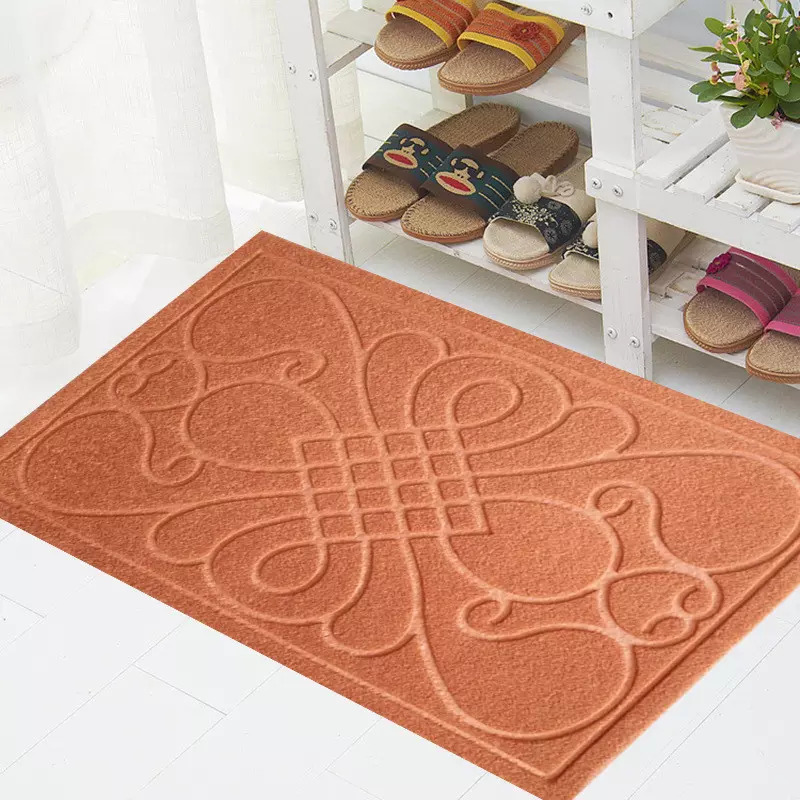
Off-the-shelf solutions frequently fail the success criteria when applied to complex architectural layouts. In these scenarios, specifying Custom Size Door Mats becomes a structural requirement rather than a luxury. You cannot force a square peg into a round hole when it comes to floor safety.
Irregular stoops, angled entryways, and extra-wide porticos require specific dimensioning. A standard rectangular mat placed on a curved or angled stoop leaves exposed corners and creates awkward walking paths. Custom sizing allows the mat to conform exactly to the geometry of the landing, maximizing coverage and eliminating unprotected zones. We often template these areas with heavy builder's paper before ordering the final product to ensure the angles are cut perfectly.
Drop-in mat wells demand strict dimensional tolerances. A mat placed in a recess must fit exactly within the perimeter frame. If the mat is too small, it will shift during use, creating dangerous gaps at the edges that can catch heels or walking aids. If it is too large, it will buckle and fail to sit flush with the surrounding floor. Exact custom sizing, usually requiring measurements down to the sixteenth of an inch, is necessary to prevent edge deterioration and ensure a seamless transition. You also have to account for the depth of the well to ensure the mat sits perfectly flush with the finished floor.
When integrating logos or specific design layouts, the overall physical dimensions must accommodate the artwork without it being obscured by door trim or sweeps. Logo alignment and border proportions dictate the final size of the mat. Shrinking a complex design to fit a standard 24" x 36" footprint often results in unreadable text or cramped graphics. Custom sizing ensures the branding is displayed prominently and proportionally within the entryway. The border width needs to frame the logo, not crowd it.
Residential properties with commercial-level foot traffic—such as large families, rural estates, or homes subjected to frequent heavy debris—often outgrow standard residential mats. Transitioning to custom roll goods or commercial sizing provides the necessary square footage to manage high volumes of dirt and moisture. These environments require extended walk-off lengths that standard retail mats cannot provide. If you live on a dirt road or have active kids and dogs, you need commercial dimensions to keep your hardwood floors intact.
Physical dimensions do not exist in a vacuum; they interact directly with material properties and environmental conditions. The size of the mat heavily influences its stability, durability, and performance in varying weather. You have to match the size and the material to the specific exposure of the entryway.
Lightweight materials behave poorly when scaled up to larger dimensions. An oversized mat made from thin vinyl or low-density fibers is highly susceptible to edge curling. As the perimeter expands, the material loses structural rigidity, causing the corners to lift and create severe tripping hazards. Heavy-duty rubber backing is an absolute necessity for any mat exceeding 48 inches in width to ensure it remains flat and securely anchored to the substrate. We reject any large-format mat that doesn't have a minimum 90-mil rubber backing.
There is a direct correlation between a mat's square footage, its overall weight, and its ability to remain stationary. In high-wind, exposed environments, a large mat acts like a sail if it lacks sufficient mass. While increasing the size provides better coverage, it must be paired with dense, heavy materials (like solid rubber or thick coir) to prevent the mat from being displaced by strong gusts. A 4x6 foot mat needs to weigh at least 15 pounds to stay put on an exposed porch during a storm.
Oversized mats placed in uncovered areas can trap excessive moisture against the foundation or wooden decking. If the mat spans the entire depth of a porch without proper drainage capabilities, it prevents water runoff and accelerates rot or concrete degradation. Sizing adjustments—such as leaving a perimeter gap for water to escape or selecting a highly porous, flow-through design—are critical when covering large exterior surfaces exposed to heavy rain. Never run a solid-backed mat tight against the siding on an uncovered deck.
Capturing accurate entryway dimensions requires a technical, foolproof process. Guesswork leads to poorly fitting mats that compromise safety and aesthetics. Grab a quality tape measure, a straightedge, and a notepad. Do not rely on architectural plans; measure the actual built conditions.
Open the door fully and measure the distance between the inside faces of the door jambs. This is your active door width and the absolute minimum width for your mat.
Close the door and measure from the outside edge of the left casing trim to the outside edge of the right casing trim. This is your maximum visual width.
If you have sidelights, measure from the far left edge of the left sidelight trim to the far right edge of the right sidelight trim.
Determine your depth by measuring from the threshold outward. Ensure you have at least 36 inches of clear space before hitting steps or a drop-off.
Open the door completely to 90 degrees.
Place a rigid straightedge (like a 4-foot level) flat on the floor, extending outward from the threshold perpendicular to the door frame.
Slowly close the door, watching the gap between the bottom weatherstripping and the straightedge.
Use a tape measure to record the clearance at the tightest point in the arc. The floor may not be perfectly level, so check multiple spots.
Subtract 1/8 inch from your tightest measurement. This is your maximum allowable mat thickness.
Rubber and synthetic materials expand in direct sunlight and contract in freezing temperatures. When measuring for a recessed well, do not order a mat that matches the exact dimensions of the recess. Deduct 1/4 inch from both the length and the width to provide the necessary tolerance for thermal expansion. Failure to account for this will cause the mat to buckle during the summer months. We see this constantly with vinyl-backed mats installed in concrete wells during the winter; by July, they look like speed bumps.
Material Type | Temperature Exposure | Required Deduction (Per 5 Linear Feet) |
|---|---|---|
Solid Nitrile Rubber | Direct Summer Sun | 1/4 inch |
PVC / Vinyl Backing | Direct Summer Sun | 3/8 inch |
Aluminum Hinge Systems | Extreme Temp Swings | 1/8 inch |
Measure your active door width from inside jamb to inside jamb to establish your minimum required mat width.
Check your threshold clearance by swinging the door over a straightedge to determine the maximum allowable pile height.
Evaluate your typical foot traffic to decide if a standard 36-inch depth is sufficient or if an extended walk-off length is required.
Filter product catalogs based on your exact dimensional requirements rather than settling for generic retail sizes.
A: The standard baseline for a typical 36-inch residential door is 24x36 inches. While 18x30 inches is common in retail, it is generally only suitable for very small entries or secondary doors, as it lacks the depth for proper foot traffic coverage.
A: A door mat should cover at least 80% of the active door width. Ideally, the mat width should match the outer door frame to provide maximum functionality and maintain visual symmetry and curb appeal.
A: Double doors require a single, continuous mat to prevent tripping hazards. Standard 60-inch double doors need a 36x60 inch mat, while 72-inch doors require a 36x72 inch mat or larger custom dimensions.
A: No. At approximately 26x47 inches, it is too narrow for standard 60-inch or 72-inch double doors. However, this metric size serves as an excellent oversized option for single doors or single doors with sidelights.
A: The base rug should be at least one standard size larger than the functional mat. This provides a consistent 2-to-4-inch border on all sides, ensuring stability and preventing the top mat from creating an uneven surface.
A: Most standard mats range from 3/8" to 5/8" thick. You must measure your specific threshold clearance by checking the door's swing arc to ensure the mat's pile height will not cause the door to bind or drag.
A: Measure the active traffic area width and desired stride depth. Check the door swing clearance to determine maximum thickness. For recessed wells, measure the exact inner dimensions of the frame and subtract 1/4 inch to allow for material expansion.