
- All
- Product Name
- Product Keyword
- Product Model
- Product Summary
- Product Description
- Multi Field Search
 English


You finally find a design you love, bring it home, and place it outside your front entrance. Immediately, you realize the problem. The mat looks disproportionately small against the door frame. Worse, it fails to capture debris effectively, or its thick profile blocks the door from opening altogether. This common frustration stems from a misunderstanding of standard entryway dimensions. Sizing varies significantly between residential and commercial applications. Incorrect dimensions compromise floor protection, create tripping hazards, and negatively impact curb appeal. A mat that is too small looks like an afterthought, while one that is too thick becomes a daily nuisance. To solve this, you need a structured evaluation framework for measuring entryways, understanding standard versus custom dimensions, and selecting the precise mat size required for optimal functionality, aesthetic balance, and safety.
Standard Residential Baseline: The most common residential door mat measures 18" x 30", designed to fit standard 36-inch single doors.
The Coverage Rule: A functional mat must cover at least 80% of the door's width to effectively capture foot traffic.
The "Two-Step" Depth Requirement: Effective soil and moisture removal requires a mat deep enough to accommodate at least two full steps (typically 3 to 5 feet in depth for high-traffic areas).
Clearance is Critical: Mat sizing must account for pile height and door threshold clearance to prevent the door from catching on the mat's surface.
Buyers often confuse residential decorative sizes with functional commercial requirements. This confusion leads to inadequate floor protection. You must match the mat's dimensions to the specific traffic volume and architectural scale of the entrance. When you install flooring systems, the first line of defense is always the entry system. If you undersize this component, you guarantee accelerated wear on your interior finishes.
Small or apartment-sized mats typically measure 16" x 24". These are ideal for tight spaces or secondary doors. However, you must note their functional limitations in high-traffic zones. They simply do not offer enough surface area to clean shoes thoroughly. If you place a 16" x 24" mat at a primary entrance, most adults will step right over it. We see this constantly in multi-family housing developments where builders provide minimal entry coverage.
The standard medium size ranges from 18" x 30" to 24" x 36". The 18" x 30" is the baseline standard for most homes. Yet, the 24" x 36" serves as the ideal medium door mat. It scales perfectly with standard American 36-inch single doors, offering better visual balance. When you center a 24" x 36" mat in front of a 36-inch door, you leave exactly six inches of exposed flooring on either side. This creates a deliberate, framed appearance.
There is an increasing trend of using premium residential large mats. These measure 3' x 5' (36" x 60"). They are commercial-adjacent sizes used in premium residential spaces. They offer double-step coverage and create a grand, welcoming aesthetic. High-end custom home builders now specify these larger formats to match oversized custom entry doors. A massive iron or solid wood door demands a substantial mat to anchor the visual weight of the entrance.
The baseline dimension for light commercial use is 3' x 5'. This size provides enough walk-off distance for moderate foot traffic. It ensures visitors take at least one full step on the cleaning surface before hitting the main floor. In small retail shops or private clinics, this is the absolute minimum requirement to keep hard surface floors dry during rain events.
Larger standard formats include 4' x 6' mats and 3' x 10' runners. These dimensions are often required for ADA compliance. They are essential for high-volume soil trapping in busy public entrances. When you manage a facility with hundreds of daily visitors, a 3' x 10' runner captures roughly 85% of tracked-in moisture. We install these long runners in school corridors and office building lobbies to reduce slip-and-fall liabilities.
International or imported mats often use metric sizing. A standard residential mat converts roughly to 500 x 850mm. Knowing these conversions helps when ordering from global suppliers. Many high-performance synthetic scraping mats originate from European manufacturers, so familiarizing yourself with metric dimensions prevents ordering errors.
A popular modern metric trend is "statement sizing." These mats measure 650 x 1200mm. Designers use them to frame wide residential entryways. They provide minimalist, clean lines that elevate the exterior architecture. Statement sizing works exceptionally well with modern farmhouse or contemporary industrial home designs, where wide, uncluttered porches are common.
You must establish technical criteria before purchasing. Evaluating your space ensures you buy Entryway Door Mats that perform well and look intentional. Guessing dimensions based on visual memory usually results in returns or compromised performance. Grab a tape measure and document the exact physical constraints of your entrance.
Start by measuring the door frame. Measure from the inside trim on the left to the inside trim on the right. This gives you the active opening width. Do not measure the door slab itself; measure the space people actually walk through.
The mat must span at least 80% of this width. If it is smaller, visitors will naturally step around it. They will track dirt directly onto your interior floors. Full coverage forces engagement with the scraping surface. For a 36-inch opening, 80% is 28.8 inches. Therefore, a 30-inch wide mat is the absolute minimum functional width.
Open the door fully to expose the entire threshold.
Place the tape measure against the inside edge of the left door jamb.
Extend the tape to the inside edge of the right door jamb.
Record this measurement as your "Active Opening Width."
Multiply the Active Opening Width by 0.8 to find your minimum mat width.
You need a framework for measuring the gap between the door bottom and the floor. Open the door halfway and measure the tightest clearance point. This dictates your maximum pile height. Many exterior doors sag slightly over time, meaning the clearance at the hinge side might differ from the latch side.
Clearance Measurement | Recommended Mat Profile | Typical Pile Height |
|---|---|---|
Less than 0.3 inches | Low-Profile / Flatweave | 1/4 inch or less |
0.3 to 0.6 inches | Standard Medium Profile | 3/8 inch to 1/2 inch |
Greater than 0.6 inches | Plush / Heavy Duty Coir | 5/8 inch or thicker |
Correlate your clearance measurements with these maximum allowable pile heights. A low-profile 1/4-inch mat works for tight modern doors. A plush 5/8-inch mat requires a high threshold. If you buy a mat that is too thick, the door sweep will grab the fibers, bunching the mat up every time you open the door. This destroys the mat backing and damages the weatherstripping.
Depth is the distance from the threshold outward. We use the "two-step" rule to determine necessary depth. Depth dictates how much dirt is actually removed from shoes. A wide mat does nothing if it is too shallow for a person to step on it naturally.
If a mat is only 18 inches deep, a person might step over it entirely. A depth of 36 inches guarantees at least one foot strikes the mat. A depth of 60 inches ensures both feet make contact, maximizing soil removal. In commercial settings, we push for 10 to 15 feet of walk-off depth, but for residential applications, aiming for 36 to 48 inches of depth provides excellent protection.
Visual balancing rules help frame an entryway properly. A mat should never look like a postage stamp in front of a grand entrance. It needs to anchor the space. The mat acts as a visual transition zone between the exterior environment and the interior sanctuary.
Calculate the "golden ratio" of door-to-mat proportions. The mat width should ideally match the door width exactly, or extend slightly beyond the trim. This makes the entryway look architecturally intentional rather than sparse. If you have large planters or columns flanking the door, size the mat to fill the space between those architectural elements.
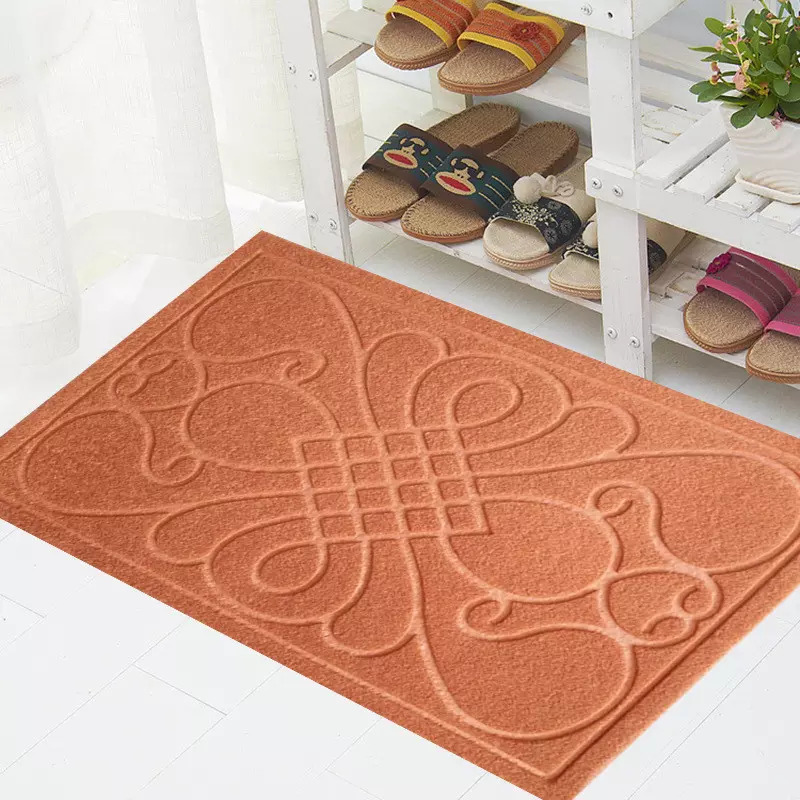
Different architectural setups require specific solution categories. Mapping dimensions to your door configuration guarantees a seamless fit. You cannot apply a one-size-fits-all approach when dealing with varied building designs.
For a standard 36-inch door, compare the 18" x 30" and the 24" x 36" sizes. The 18" x 30" offers minimalist, functional coverage. The 24" x 36" provides well-proportioned framing. We always recommend the 24" x 36" for primary entrances because it handles the stride length of an average adult much better.
Focus on aesthetic proportions. You want equal exposure of the flooring on either side of the mat. Center the mat perfectly to maintain symmetry. If your porch is narrow, ensure the mat does not hang over the edge of the top step, which creates a severe tripping hazard.
Double doors require much larger coverage. Identify the minimum requirement of a 48-inch to 72-inch wide mat. You will often utilize a 3' x 5' or 3' x 6' layout here. When both doors are active, a standard single mat leaves half the entrance completely unprotected.
Evaluate the risks of using two small mats side-by-side. This creates shifting issues and tripping hazards. It also results in visual clutter. A single, continuous mat is always safer and more attractive. Two mats will inevitably separate, leaving a gap right in the center where most people walk.
Door Configuration | Total Opening Width | Recommended Mat Size |
|---|---|---|
Standard Double Doors | 72 inches | 36" x 72" or 48" x 72" |
Narrow French Doors | 60 inches | 36" x 60" (3' x 5') |
Oversized Double Doors | 96 inches | 48" x 96" (4' x 8') |
Entryways with glass sidelights require a specific sizing framework. You must decide whether to size strictly to the active door width, or size to span the entire architectural frame. This decision impacts both budget and visual impact.
Sizing to the active door is functional and cost-effective. Sizing to include the sidelights creates a luxurious, expansive feel. Choose based on your exterior space constraints and design goals. If you size to include the sidelights, ensure the mat depth increases proportionally so it does not look like a long, skinny ribbon across the porch.
Sometimes off-the-shelf options fall short. Analyzing the trade-offs between convenience and bespoke solutions helps you determine overall value. Standard sizes work for 80% of applications, but the remaining 20% require specialized fabrication.
Many buildings feature unique entrances. Revolving doors, recessed floor wells, vestibules, and angled entryways require exact-fit dimensions. Standard rectangles simply will not work here. If you try to force a standard mat into a recessed well, the edges will curl, or you will have dangerous gaps.
In these cases, Custom Size Door Mats are mandatory. They prevent gaps where dirt accumulates. They also ensure the mat sits flush, eliminating edge curling and trip hazards. We template these complex spaces using heavy builder's paper before cutting the final mat material to ensure a zero-tolerance fit.
Personalized mats have strict sizing constraints. You must ensure proper margins around the text or logo. If the mat is too small, the design looks cramped. A large logo on a tiny 18" x 30" mat loses all visual impact and looks unprofessional.
Ensure proper text sizing so design elements remain visible. You do not want heavy door swings or threshold overlaps obscuring your monogram. Custom sizing allows you to control the exact canvas area for your graphics. We recommend leaving at least a 4-inch blank border around any custom text or logo to frame it properly.
Standard mats often fail in busy lobbies. Evaluate the return on investment for custom sizing in these environments. High traffic demands 10-to-15 feet of walk-off depth. A standard 3' x 5' mat in a hospital entrance will saturate with water within the first hour of a rainstorm.
Custom lengths allow you to cover the entire vestibule. This drastically reduces interior cleaning costs. It also prevents slip-and-fall accidents on wet interior floors. When you calculate the cost of daily floor scrubbing versus the one-time cost of a custom walk-off system, the custom mat pays for itself in a matter of months.
Compare the upfront premium of custom sizing against long-term benefits. Custom mats cost more initially. However, they last longer because they fit the space perfectly and do not shift underfoot. A mat that shifts constantly grinds dirt into the floor beneath it, causing permanent abrasion damage.
An exact fit protects your surrounding flooring better. It reduces maintenance time. For difficult entryways, the higher initial cost is easily justified by superior performance. You spend less time adjusting the mat and more time enjoying a clean, safe entrance.
Measure your active door width and multiply by 0.8 to find your minimum functional mat width.
Check your door swing clearance with a tape measure to select a pile height that will not catch on the weatherstripping.
Select a mat depth of at least 36 inches to guarantee visitors take two full steps on the scraping surface.
Order custom dimensions if your entrance features recessed wells, double doors with sidelights, or heavy commercial traffic.
A: The most common standard size for a residential single door is 18" x 30". However, a 24" x 36" mat often provides better visual proportions and superior dirt-trapping coverage for a standard 36-inch wide door.
A: Thickness depends on your door clearance. Measure the gap between the bottom of your door and the floor. Choose a pile height that is at least 1/8-inch lower than your clearance measurement to prevent the door from catching.
A: It is highly discouraged. Placing two small mats side-by-side creates a tripping hazard where the edges meet. They will also shift constantly. A single, continuous mat measuring at least 48 to 72 inches wide is the safer choice.
A: A functional mat should cover a minimum of 80% of the active door width. This ensures visitors cannot easily bypass the mat, forcing them to wipe their shoes before entering the building.
A: You need a custom mat when dealing with recessed floor wells, revolving doors, angled entryways, or unusually wide double doors with sidelights. Custom sizing is also required when you need a specific walk-off depth exceeding standard lengths.